
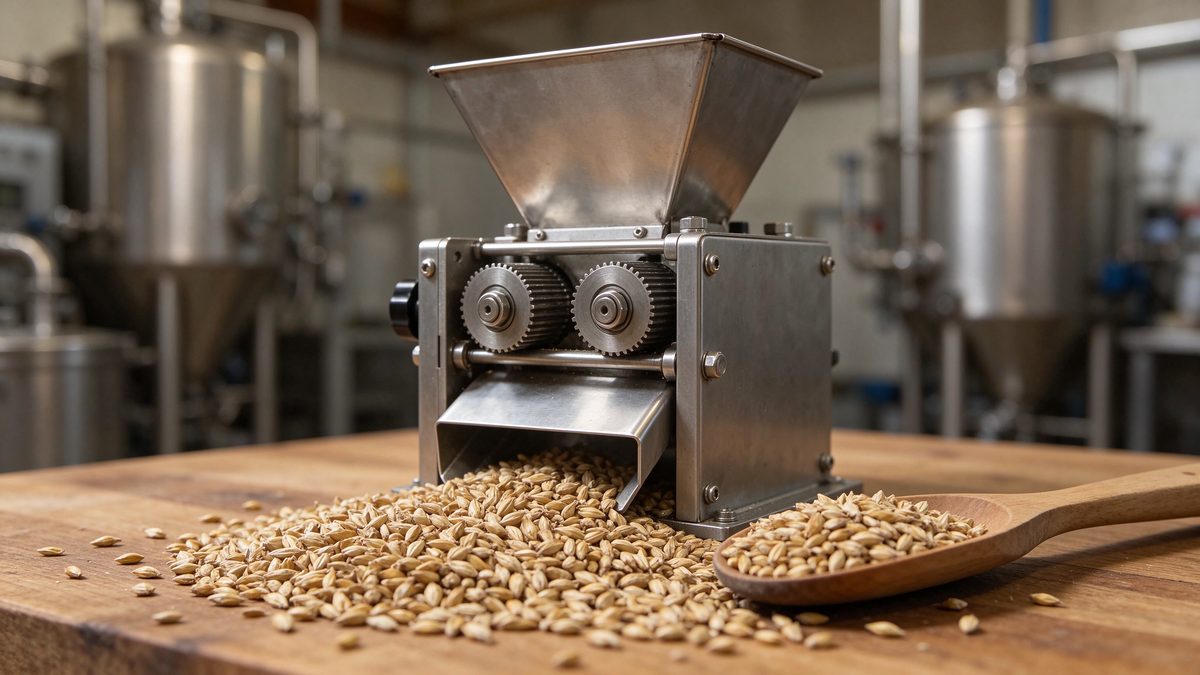
For brewery and distillery buyers, the malt crusher directly affects grist consistency, lautering efficiency and final product quality. Choosing the right supplier means balancing machine performance, material standards, customization support and after-sales reliability.
1. Roller design and gap adjustability
Look for hardened steel rollers with a clearly adjustable gap. A two- or three-roller layout should produce uniform crushing while keeping husks intact for better filtration. Ask the supplier for roller material, diameter and adjustment range before ordering.
2. Food-grade contact materials
All parts touching grain should be SUS304 or equivalent food-grade stainless steel. Confirm surface finish, cleaning access and sealing details, especially for equipment exported to regulated markets.
3. Capacity and motor configuration
Match crusher capacity to your mash schedule, not just the advertised maximum. Verify motor voltage, phase, drive type and whether the machine can be adapted to your local power supply.
4. OEM and customization
If you plan to resell under your own brand or integrate the mill into a larger line, check whether the supplier offers custom hoppers, frames, labeling, capacity ranges and private-label packaging. Long-term mold and spare-part support matter as much as the initial price.
5. Quality control and export delivery
Request in-running trial records, dimensional inspection reports and clear export packaging plans. Reliable suppliers provide container loading support, shipping documentation and a responsive contact for spare parts.
DaiYang supplies malt crushers, grain grinders, precision molds and smart equipment with OEM/ODM support. Contact our team with your capacity and material requirements for a factory-direct proposal.